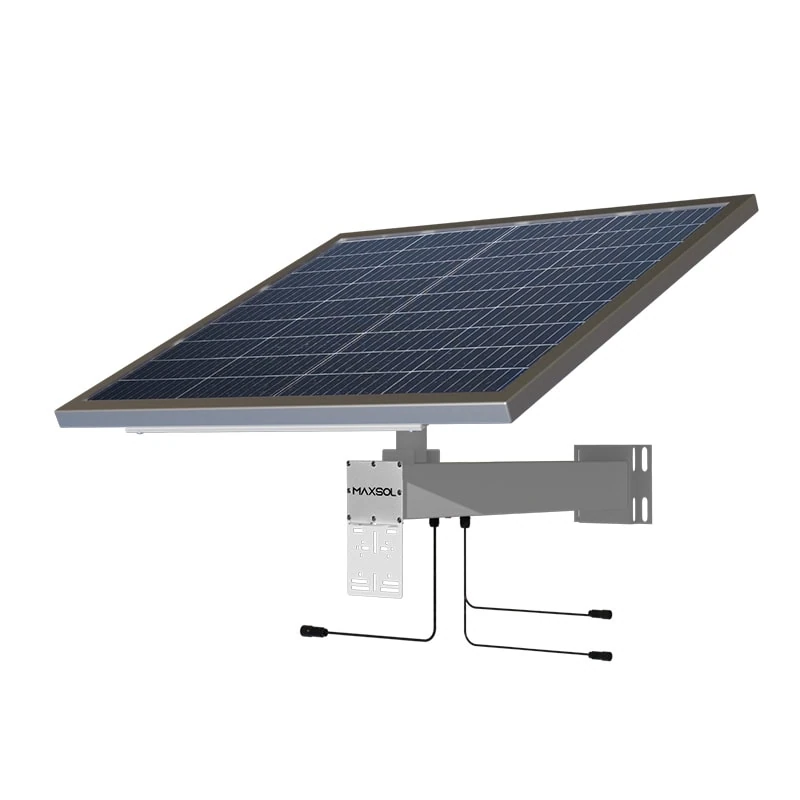
LiFePO4 Battery for Solar CCTV: Malaysia Sizing Guide
Learn how to size a LiFePO4 battery for solar CCTV in Malaysia, including usable energy, rainy-day autonomy, charging, heat and monitoring checks.
By Maxsol Team

A LiFePO4 battery for solar CCTV should be selected around the site’s real 24-hour energy demand, not camera count alone. The battery must carry the load overnight and through reduced solar generation, while leaving enough capacity for protection limits, conversion losses and battery ageing.
For Malaysian outdoor sites, sizing needs to account for cloud cover, prolonged rain, shading from trees or buildings, high enclosure temperatures and the power draw of every connected device. This includes cameras, PoE switches, wireless bridges, routers, recorders where applicable, lighting, heaters, fans and any DC-to-AC inverter.
Why battery chemistry matters
LiFePO4, short for lithium iron phosphate, is a lithium battery chemistry commonly considered for solar-powered CCTV because it can suit repeated charging and discharging in an off-grid system. Compared with a battery selected only by nominal amp-hour rating, a properly specified LiFePO4 setup can offer a more practical basis for managing an always-on DC load.
For a solar CCTV deployment, the battery chemistry matters because the power system must do more than start a device. It must support continuous operation through night-time, variable solar input and changing site conditions.
Key considerations include:
- Voltage compatibility: The battery voltage must match the charge controller, PoE equipment, DC converters and any inverter used in the design.
- Charge behaviour: The solar controller must have a charging profile appropriate for the battery type and voltage.
- Discharge protection: The system should prevent excessive discharge that could cause a shutdown or reduce the battery’s long-term serviceability.
- Temperature behaviour: Battery charging and discharging limits can change with temperature, especially inside sealed outdoor cabinets.
- Monitoring: A remote site is easier to maintain when voltage, battery state, charging status and alarms can be checked without an unnecessary site visit.
LiFePO4 does not remove the need for good system design. A small battery can still run flat during several poor solar days, while an incorrectly configured controller can limit charging or trigger avoidable protection events. The battery, solar array, controller, distribution hardware and CCTV load need to be designed as one system.
Capacity versus usable energy
Battery capacity is often shown in amp-hours (Ah), but watt-hours (Wh) are more useful for comparing it with CCTV energy consumption.
The basic relationship is:
Battery energy (Wh) = nominal voltage (V) × capacity (Ah)
For example, a 12.8V, 45Ah battery is rated at:
12.8V × 45Ah = 576Wh
However, rated energy is not automatically the same as energy available to the CCTV equipment. Usable energy depends on the system’s configured discharge limit, battery protection settings, DC-DC conversion losses, cable losses, temperature and the reserve kept for reliable operation.
A practical sizing process therefore uses two different figures:
- Nominal battery energy — the published Wh rating.
- Design-usable energy — the portion conservatively available after applying the system’s permitted discharge range and expected losses.
Do not assume that all rated battery energy should be consumed every day. The system designer should define an operating reserve, particularly for sites where access is difficult or surveillance coverage is critical.
Calculate the daily CCTV load first
Start by listing every device that runs from the solar system, then calculate its average daily energy use.
Daily energy use (Wh/day) = average power draw (W) × operating hours per day
A device drawing 10W continuously consumes approximately:
10W × 24 hours = 240Wh/day
For an always-on CCTV site, add together the average loads of:
- IP cameras, including infrared or white-light operation at night
- PoE switch or PoE injector
- Wireless CPE, bridge, access point or cellular router
- Network video recorder, if installed at the same off-grid location
- DC converters and controller standby consumption
- Cabinet ventilation, fans or lighting
- Any inverter losses for AC-powered equipment
Night-time power can be materially higher than daytime power. Cameras may activate infrared LEDs, illuminate scenes, rotate, zoom or increase processing demand when lighting conditions change. Use the equipment’s actual power data and, where possible, measure a representative installation.
Avoid using camera count as the sizing method
“Four cameras” is not a power requirement. Four fixed cameras, four PTZ cameras and four cameras with active illumination can have very different consumption profiles. The same applies to PoE switches: their own power draw and the total PoE load must both be included.
It is also important to distinguish between:
- Peak load — the highest momentary or simultaneous demand;
- Average load — the typical power consumed over 24 hours; and
- Surge or start-up load — relevant to devices such as an inverter, fan or certain network equipment.
The battery and protection devices must safely support expected peak current, while energy sizing should be based on a realistic daily load profile.
Autonomy and recharge planning
Autonomy is the amount of time a battery can power the CCTV system without sufficient solar charging. For a 24/7 solar CCTV site, autonomy should cover the normal overnight period and a planned allowance for poor weather or reduced panel output.
The simple planning method is:
Required design-usable battery energy = daily load × required autonomy days
If the measured CCTV system uses 300Wh per day and the design calls for two days of autonomy, the system needs enough usable stored energy to cover approximately 600Wh before allowing for any further design margin. Whether a particular battery capacity is suitable depends on the permitted discharge range and all system losses, not on the nominal Wh rating alone.
Plan around Malaysia’s weather and site conditions
Malaysia receives strong solar resource overall, but solar production is not uniform every day. Heavy rain, extended cloud cover, haze, seasonal weather patterns and local shading can significantly reduce energy harvested by the panels.
For an installation at a guardhouse, construction perimeter, farm, utility compound, car park or remote roadside location, assess:
- Panel orientation and tilt
- Shading at different times of day
- Tree growth, new buildings and temporary structures
- Soiling from dust, leaves, bird droppings or site works
- Rainwater drainage and physical access for cleaning
- Whether the CCTV load increases at night
- The number of consecutive low-generation days the site should tolerate
A design that works during a clear-weather demonstration may not maintain the required reserve after several cloudy days. Autonomy planning is therefore a service-continuity decision, not simply a battery-size decision.
The solar array must also recharge the battery
A larger battery provides more stored energy, but it also needs enough solar input to recharge after a deficit. If the solar array is too small for the daily load and local conditions, the battery may gradually lose charge over successive days even though it appears large on paper.
The recharge assessment should include:
- Expected energy generation at the installation location
- Controller efficiency and charging behaviour
- Battery charging limits
- Cable and conversion losses
- Daily energy consumed while charging is taking place
- Time available to restore battery reserve after poor weather
For example, a battery that has supplied most of its stored energy after a storm needs sufficient surplus solar generation to recover, not merely enough generation to run that day’s load. Ask the designer to show both the daily energy balance and the recovery plan.
Do not rely on nominal panel wattage alone
Solar modules are rated under specified test conditions. Real output varies with sunlight, panel temperature, dirt, orientation, shading and controller behaviour. A solar array’s nominal wattage is useful for comparison, but it is not a guaranteed daily energy figure for a specific site.
Where a controller is part of the system, verify its operating voltage range, charging configuration and battery compatibility. The CS6030 product documentation, for example, identifies MPPT control alongside its 12.8V 30Ah 384Wh LiFePO4 battery; this does not remove the need to validate the complete load and site energy calculation.
Temperature protection and monitoring
Heat management is particularly important for outdoor solar CCTV systems in Malaysia. A metal cabinet in direct sun can become much hotter than ambient air, while a poorly ventilated enclosure may retain heat from networking equipment, PoE power conversion and the battery itself.
Battery temperature affects charging acceptance, available energy and protective behaviour. The battery documentation should state the permitted charging and discharging temperature ranges. Do not assume that a battery suitable for general outdoor use can be charged safely at every enclosure temperature.
Verify the protection functions
Ask what protection is provided by the battery and by the wider power system. At a minimum, the specification should clarify how the installation handles:
- Over-charge protection
- Over-discharge protection
- Over-current and short-circuit conditions
- High- and low-temperature charging limits
- High- and low-temperature discharge limits
- Reverse-polarity risks during installation
- Surge and lightning exposure on outdoor power and data cabling
- Isolation for maintenance and fault finding
Protection should be considered at system level. A battery protection circuit alone does not replace correctly rated fuses, breakers, cable sizing, earthing arrangements, surge protection or a suitable cabinet layout.
Monitor energy, not only battery voltage
Voltage is useful, but it is not enough for reliable remote management. A battery can show a reasonable voltage while the system is consuming more power than solar generation can replace.
Useful monitoring points include:
- Battery voltage and, where available, battery current
- Charge and discharge status
- Solar charging current or energy harvested
- Load current and total daily consumption
- Controller faults or protection events
- Battery temperature, if supported
- Cabinet temperature and door status
- PoE switch and network-device status
For critical surveillance locations, set alerts before the battery reaches a shutdown condition. A low-energy warning gives the operations team time to investigate shading, dirty panels, a failed camera, an unexpected network load or a controller fault.
Compare approved LiFePO4 capacities
The following Maxsol solar system options document 12.8V LiFePO4 battery capacities from 384Wh to 1280Wh. These figures are nominal battery energy ratings. They are not universal runtime estimates, because actual operating time depends on the CCTV load, configured protection limits, solar input, temperature and installation losses.
| System reference | Documented battery specification | Nominal battery energy | Suitable comparison question |
|---|---|---|---|
| CS6030 | 12.8V 30Ah LiFePO4 | 384Wh | Does the measured daily load leave sufficient overnight and weather reserve? |
| CS8040 | 12.8V 45Ah LiFePO4 | 576Wh | Is the added storage enough for the required autonomy after losses and reserve? |
| CS12060 | 12.8V 60Ah LiFePO4 | 768Wh | Can the site restore this battery’s reserve after poor weather? |
| CS200100 | 12.8V 100Ah LiFePO4 | 1280Wh | Does the higher stored energy match the criticality and recharge capability of the site? |
For a smaller continuous load, review the documented 12.8V 30Ah, 384Wh battery in the CS6030 384Wh solar system. Its documentation also identifies MPPT control, but the final application should still be sized from measured load and local solar conditions.
Where the energy calculation points to a mid-range storage requirement, compare the CS8040 576Wh solar system with a 12.8V 45Ah LiFePO4 battery. Confirm how much of the nominal energy is intended to be used in the proposed configuration and whether the system can replenish its reserve.
For sites with higher daily consumption, longer planned autonomy or a larger network load, consider the CS12060 768Wh solar system with a 12.8V 60Ah LiFePO4 battery. Higher battery energy can improve resilience only when charging capacity, thermal conditions and protection design are also suitable.
The CS200100 1280Wh solar system with a 12.8V 100Ah LiFePO4 battery provides the largest documented nominal storage figure in this comparison. It should not automatically be selected as the “best” option: the system still needs a defensible solar-energy and recharge calculation.
Common sizing mistakes to avoid
Several mistakes can lead to unreliable solar CCTV operation:
- Sizing from camera quantity instead of measured watts and daily Wh
- Ignoring higher night-time camera consumption
- Treating nominal battery Wh as fully available energy
- Selecting storage without checking recharge capability
- Leaving no allowance for cloudy or rainy periods
- Ignoring switch, router, wireless bridge and conversion losses
- Installing panels where later shading is likely
- Placing a battery in a heat-trapping enclosure
- Omitting low-energy alerts and fault monitoring
- Adding an inverter for a small load without accounting for its standby and conversion losses
Questions to verify with the system designer
Before specifying a LiFePO4 battery for solar CCTV, request clear answers to the following questions. They help procurement teams and installers compare proposals on a like-for-like basis.
Load and runtime questions
- What is the measured or documented average power draw of every device?
- What is the night-time load when infrared, illumination or PTZ functions are active?
- What is the peak current requirement?
- Is the design based on DC equipment, or does it include an inverter?
- How many hours or days of autonomy are required?
- What battery reserve is retained before low-voltage protection operates?
- What runtime is expected under the stated assumptions, rather than as an unconditional claim?
Solar and charging questions
- What daily solar energy figure has been used for the actual installation location?
- How were rain, cloud, shading, dirt and seasonal variation considered?
- What is the expected daily energy balance: generation versus consumption?
- How long should recovery take after a low-solar period?
- Is the controller compatible with the battery voltage and charging requirements?
- Are panel mounting, cable runs and voltage drop included in the calculation?
Protection, environment and management questions
- What over-charge, over-discharge, over-current and temperature protections are provided?
- What fusing, isolation and surge protection are included?
- What enclosure temperature range is expected in direct sun?
- How are heat, condensation and ventilation managed?
- Which values can be monitored remotely?
- What alarms are sent when charging is low, battery energy is falling or a device goes offline?
- How will the system be inspected and maintained after installation?
The right LiFePO4 battery for solar CCTV is the one that supports the verified load, required autonomy and realistic solar-recharge conditions at the site. Compare the linked Maxsol models against your port count, load, distance, power environment and management requirements before making a final system selection.